The Politics of Coffee

When Equal Exchange arranged this trip to Peru I was excited on many levels. I couldn’t wait to see the coffee growing, help with the harvest, taste the product etc. Delving into the political history of coffee growing in Northern Peru and participating with a political party based on small farmer support was an intriguing sidebar.

I suppose a condensed history is in order to understand the current political movement about what’s going on today and why fair trade is critical for it’s continued success.
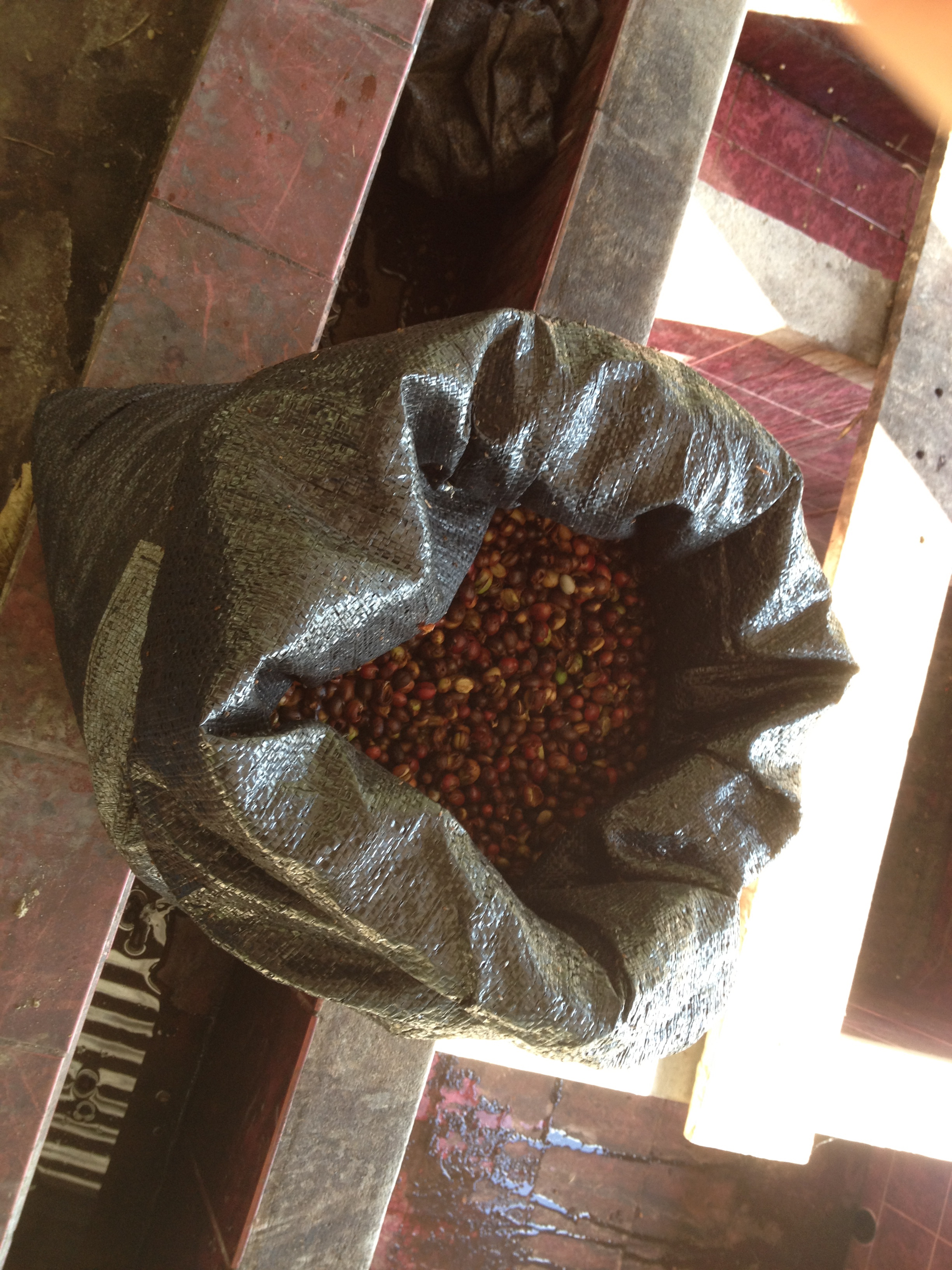
coffeebeans

Spanish colonialism, which was really slave trade, ruled farming in Peru through the end of WWII. There wasn’t a lot of change until the 1960s when there was a push, by the farmers, for agrarian reform that resulted in guerrilla revolts and land grabs. While this was quasi-successful it wasn’t a viable long term solution.

Under Juan Velasco Alvarado’s leadership came real agrarian reform. His platform was justice for the poor and part of that was cutting farmland into plots and giving it to people who were actually working the land.  In the later 70s the Co-op movement began but was undermined by the fact that the old hacienda owners were in it for personal gains.  It was not truly a democratic movement quite yet.

During the 80s terrorists prevailed and farmers were back in a land grab scenario with terrorists taking over farms to grow coca (cocaine).  Peru was also suffering from hyperinflation, the result of another government corruption issue. As they moved into the 90s, under Fujimora, a grassroots co-op movement began and that is where the Jose Gabriel Condorcanqui (JGC) (the co-op I spent time with) story begins for us.

This particular co-op came together in 1969 and 4 of the original 34 members still participate with today’s 250 members. In 1994 they sent their first ½ container of unwashed coffee to the US. In 1997 they began a partnership with Equal Exchange and of the 2 ½ containers of coffee exported, 1 was for Equal Exchange exclusively. They received $1.40 per lb for what was sold to Equal Exchange vs. the $0.38 that was the current commodity price on the open market. It was the beginning of a great relationship.
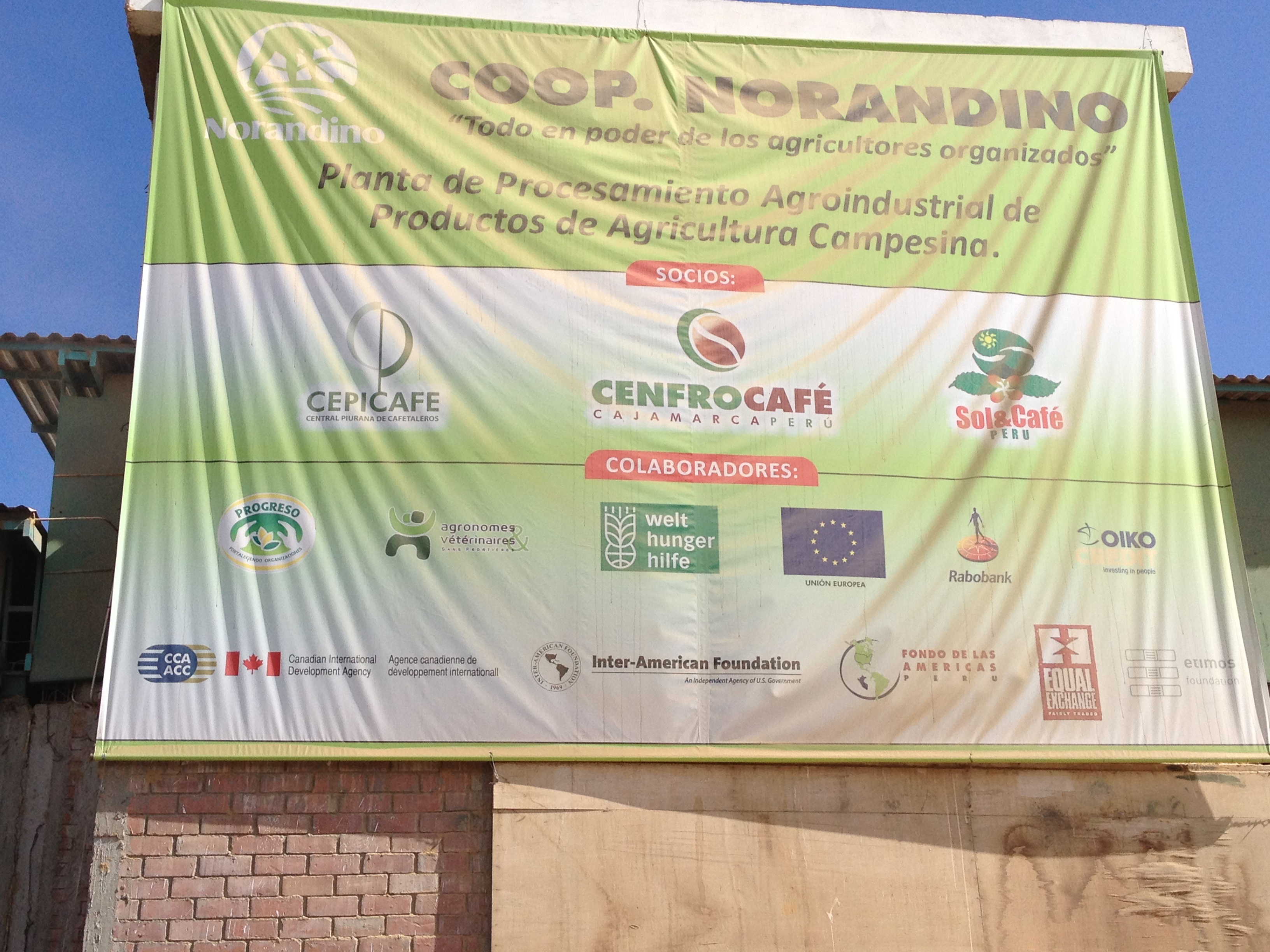
coffeeNorandino

JGC participates with an organization that coordinates the co-ops, Cepicafe. They are undergoing a transition currently. They are changing their name to Norandina because as the co-op movement has grown they’ve diversified into cacao and panela (sugar) so it made sense to broaden the namesake from just ‘café’. Cepicafe will remain as a non-profit sister to Norandina.

Perhaps the most exciting part of the trip was meeting with Piura Para Todos (Piura for All), the political party focused on small producers that was started in 2009. The coffee and banana trades were the industries that helped drive the party into existence. There are a lot of small producers in those industries in Peru and spread over almost the entire geographic region. As a result Piura Para Todos has presence in all 8 regions in the country.

The fundamentals are this. Piura Para Todos offers a place for successful co-op leaders to grow and influence a bigger group. There is also a built in support network between the co-ops as they generally want each other to succeed. Social inclusion is critical as Peru has had a history of class issues especially toward the mountain cultures. Historically agricultural projects have been in the governmental ‘budget’ but rarely have the funds made it down to the municipal level. Agriculture is such a large part of Peru’s economy and PPT believe that there is opportunity for an intersection of private and public interest.

coffeecepicafe

What’s refreshing is that there are supporting non-profits like Progresso. They are The Association Promoting Rural Economic and Social Management. They help out on a range of organizational issues within coops and encourage women to be more involved in a traditionally male-centric coffeechocolatefield. They also support on a technical level with hands on agronomists who train side by side with the co-op members to promote sustainable agriculture practices.

How then does fair trade really play into this? As I mentioned earlier, Equal Exchange paid quite a bit more than the market price for JGC’s coffee. Fair Trade provides small producers with long term buying relationships. Rather than a one time buyer who snaps up the entire crop, possibly at a reduced price, never to return, fair trade ensures that the co-ops have steady business and prices so that they can grow steadily as well.  They get pre-harvest money so that they can invest in a successful harvest and it eliminates the middle men who drive price up for themselves but not the farmers.

Here in North America we don’t grow any coffee (unless you count Hawaii) which means we rely on our Central, South American and African friends to supply us with our daily cup.  I implore you to remember as you inhale the aroma of your next cup of Equal Exchange coffee that you consider the political choice you made in choosing a cup of Fair Trade.

Claudia works at MOMs Central.

coffeehat

Posted in Organic Food | Tagged , , , , , , , , , , , , , , , | Leave a comment

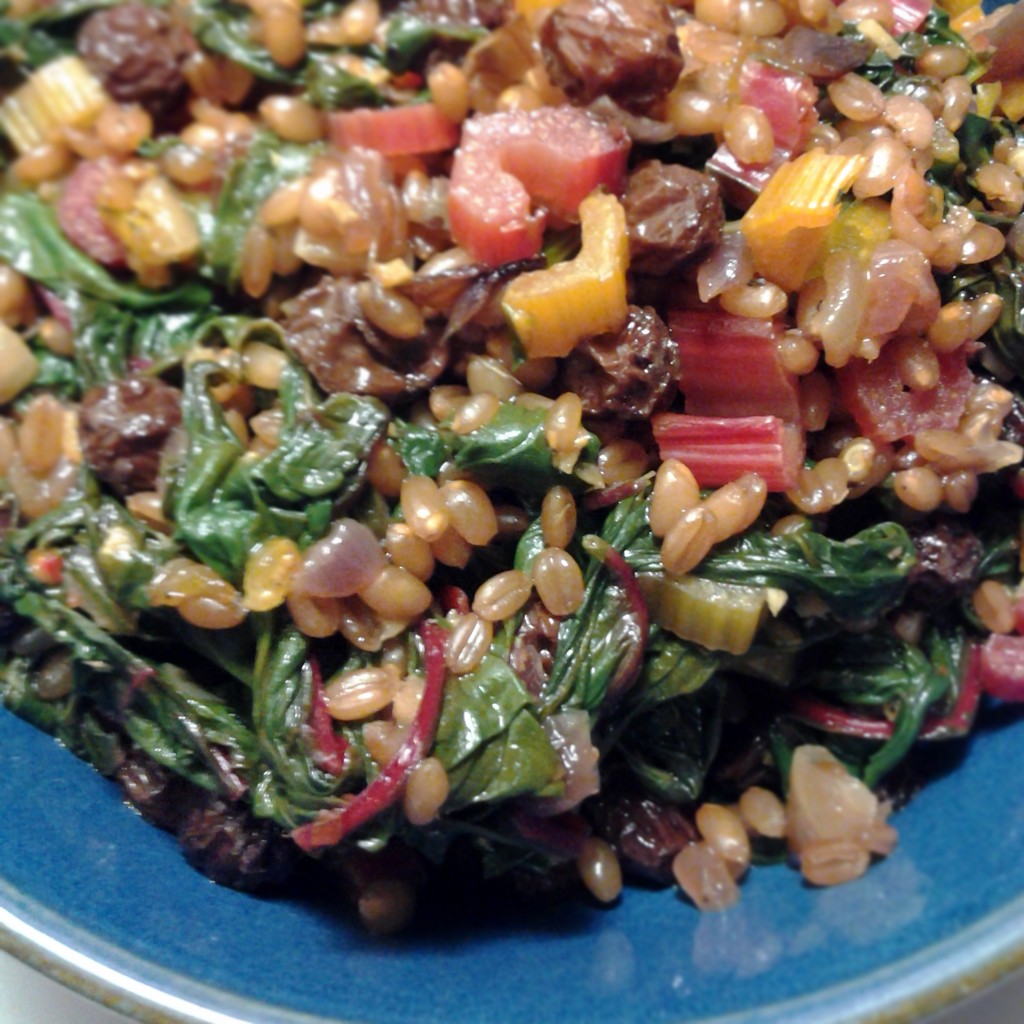
Chard and Berry Sauté

well… a type of berry.    why not add a little crunch to your sautéed chard, with wheat berries?!   i solicited them for their crunch-factor in this instance, but lucky for us, they’re a great source of fiber and minerals too!

we sell them in several varieties at MOM’s, in our dry bulk section and in packages near the rice.

i dreamed this up yesterday morning, in a plan to pair it with salmon for dinner. but it will go well in my packed lunch with quinoa too!  i’d like to try it with tempeh in the future.

chard and berry sauté

handful hard red winter wheat berries

handful raisins

1/4 red onion, chopped

1/4 white onion, chopped

thumb-sized nib fresh ginger, freshly chopped

splash extra virgin olive oil

splash canola oil

careful splash sesame chili oil

sprinkle ginger powder

sprinkle garlic granules

several sprinkles cracked red pepper flakes

sea salt and ground black pepper to taste

so, boil the wheat berries and raisins in a small sauce pan to start.  leave those on the stove  while you’re chopping your veggies and washing your chard.  wheat berries need to cook for a while.  once they’re finished, drain 2/3 of the water from them, but save a little.

when you’re ready, (meaning the wheat berries are done cooking and the raisins are plump) sauté the chopped onion with the oils and spices.

when the onions are soft and have browned a little, lower the heat.  add the chard, chopped chard stems and all. stir to coat the leaves with oil.

pour the wheat berries and raisins, and they’re remaining raisin-sweetened water, into the sauté pan with the chard and the onions.  the water will help to steam the chard, and will add a little sweetness to complement the spices.

in a matter of minutes, your chard and berry sauté will be ready to serve!

Chard & Berry Salad

Chard & Berry Salad

disfruta!  🙂

Adrienne works at MOMs Rockville.

Posted in Nutrition, Organic Food, Recipes, Vegetables | Tagged , , , , , , , , , , , , , , , | Leave a comment

Chilled Bean Salad 2.0

i get really syked about vegetables …and food that does a body good.

MOM’s is a great place, not only to find the building blocks for fabulous meals, but to share ideas about food and how to make the most with what we have.  …after all, we have more than most.  shouldn’t we do our best to use what we have, use it well, and use it all?   if you can’t eat it yourself, then share it!   🙂

this bean salad, which we prepared and sampled at our customer service desk a few weeks ago, is a great way to use up lots of leftover fresh vegetables.  i don’t know about you, but there’s a whole corner of my refrigerator with halves of onions, tomatoes, peppers, ginger, and stalks of celery!

you may have picked up a copy of the recipe the other week, it was called, simply, “chick pea salad.”   i took a copy home, to use a guide, but ultimately, made it work for me, based on what was already in my kitchen. everything can be acquired at MOM’s.  how convenient!  🙂

i had a can of “salad beans” on hand, so my salad was a little more varied.

beans

photo by James Keith, adactio

chilled bean salad

1 (15oz) can garbanzo beans

1 (15oz) can salad beans

1/2 large red onion, finely chopped

few ribs celery, chopped

1/2 bell pepper, finely chopped

few cloves garlic, finely chopped

half tomato, chopped

few shakes of cracked red pepper flakes

few pinches rosemary sprigs

splash of rice vinegar

tiny splash of apple cider vinegar

generous splash of extra virgin olive oil

sea salt and ground black pepper

combine. and let the flavors mingle!   this salad is best at room temperature, so the olive oil is liquified.  i take it out of the refrigerator about 20 minutes before i’m ready to serve it. it’s great as a snack, a side dish, packed in a lunch, or on a bed of fresh greens.  enjoy!

Chilled Bean Salad 2.0

Chilled Bean Salad 2.0

Adrienne works at MOMs Rockville.

Posted in Organic Food, Recipes, Vegetables | Tagged , , , , , , , , , , , | 1 Comment

What’s Cookin? Home-made Pizza Crust with Goat Cheese Topping

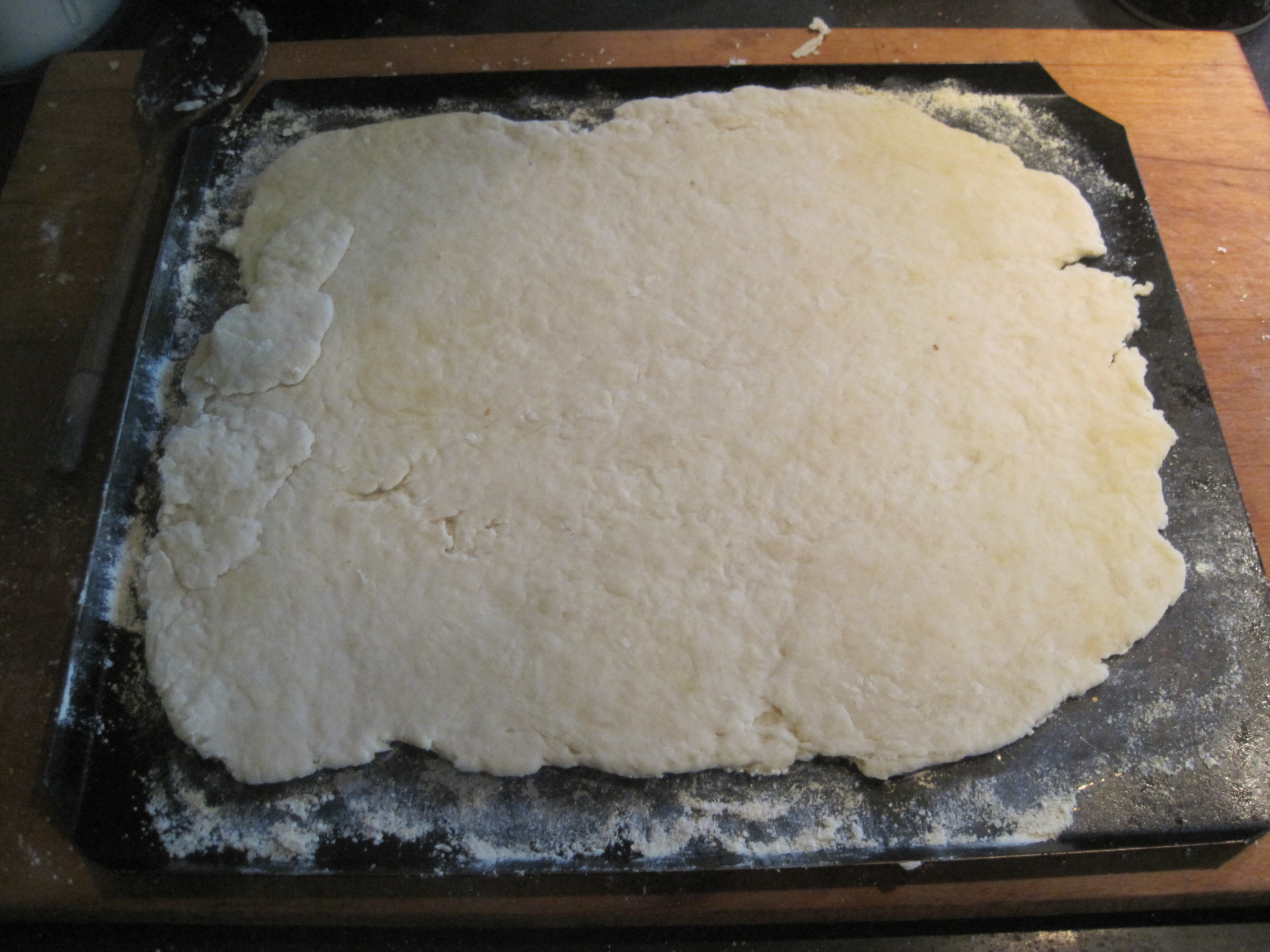
IMG_2426Ever made your own pizza crust?  I hadn’t until last night, and this recipe makes it is!  The simple dough doesn’t require time to rise so you can make a pizza in just over an hour.  For a change of pace I used sun-dried tomatoes, goat cheese and caramelized onions on top.

This recipe is vegetarian.  Makes pizza for 4 and takes 1 hour. 

Home-made Pizza Crust with Goat Cheese Topping

Ingredients:IMG_2416
For the crust:
2 1/2 cups unbleached white flour
2 1/2 tsp. baking powder
1 tsp. salt
2 Tbs. melted butter or olive oil
3 cloves garlic, crushed (optional)
3/4 cups water
Cornmeal

IMG_2418For the topping:
1 8 oz. (or similar) jar sun-dried tomatoes in olive oil, drained and sliced into strips
2 onions, diced
2 cups goat cheese
1/2 cup balsamic vinegar
2 Tbs. honey
Salt & Pepper to taste

IMG_2419Instructions:
Preheat the oven to 400 Continue reading

Posted in Recipes | Tagged , , , , | 1 Comment

Picking Coffee in Peru – or how I spent my summer vacation!

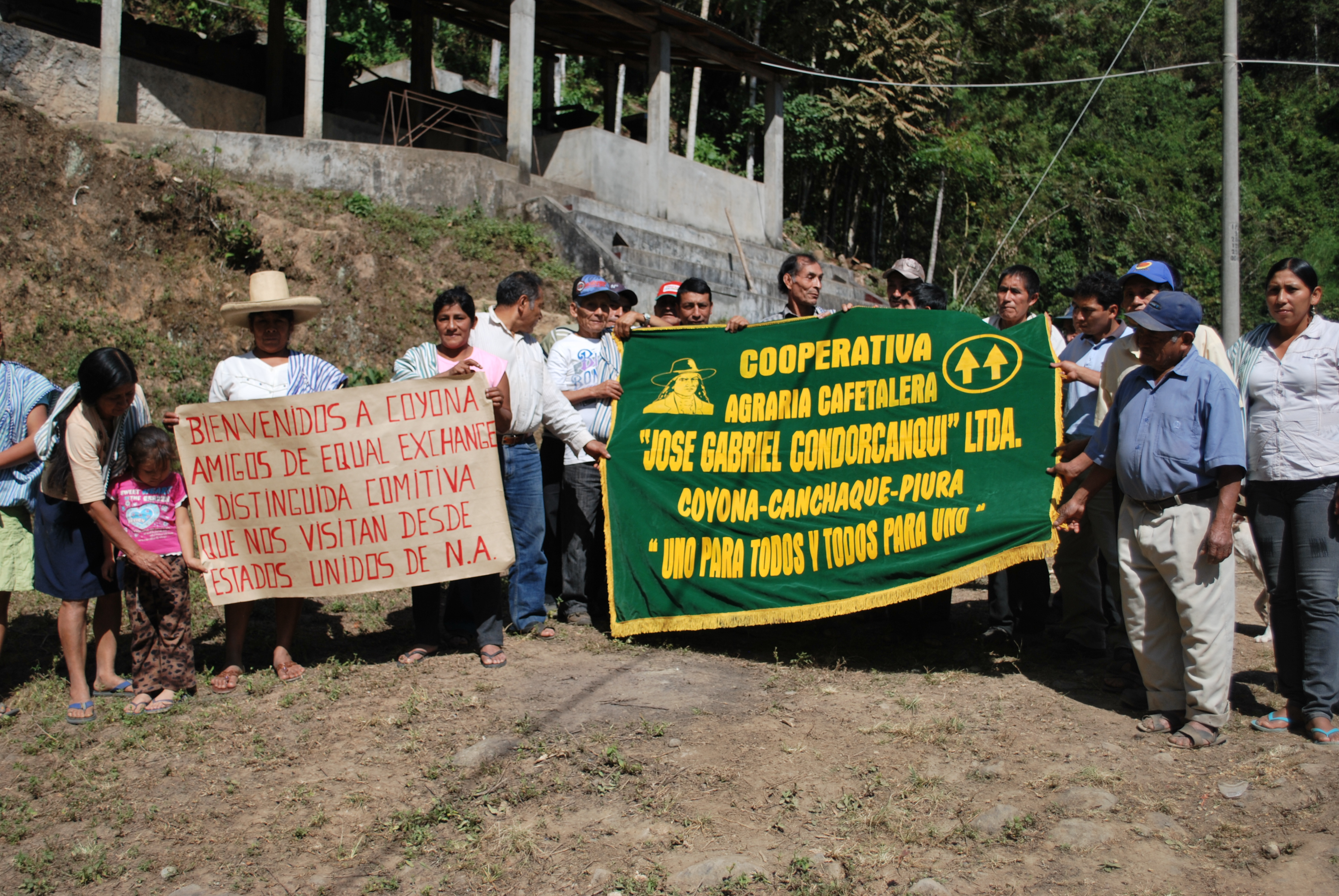
This July I had the amazing opportunity to visit Coyona, Peru with Equal Exchange to harvest coffee with the Jose Gabriel Condorcanqui Co-op (JGC) and to learn about how Fair Trade works in the most fundamental way.

The co-op began in 1969 in Coyona, Peru and four of the original 34 members are still participating. They now have 250 members, both men and women. The warm hearts and friendly faces endeared these people to me as we spent 3 days side by side sharing in their homelife, their harvest, and a fiesta. Here’s what I learned.

Image

Equal Exchange began partnering with JGC in 1997 through Cepicafe. Cepicafe is an umbrella organization that represents 6600 small producers in Northwestern Peru. Those 6600 producers are grouped into 90 smaller organizations. JGC is one of those co-ops. They send their coffee from Coyona to Piura to be processed and exported.

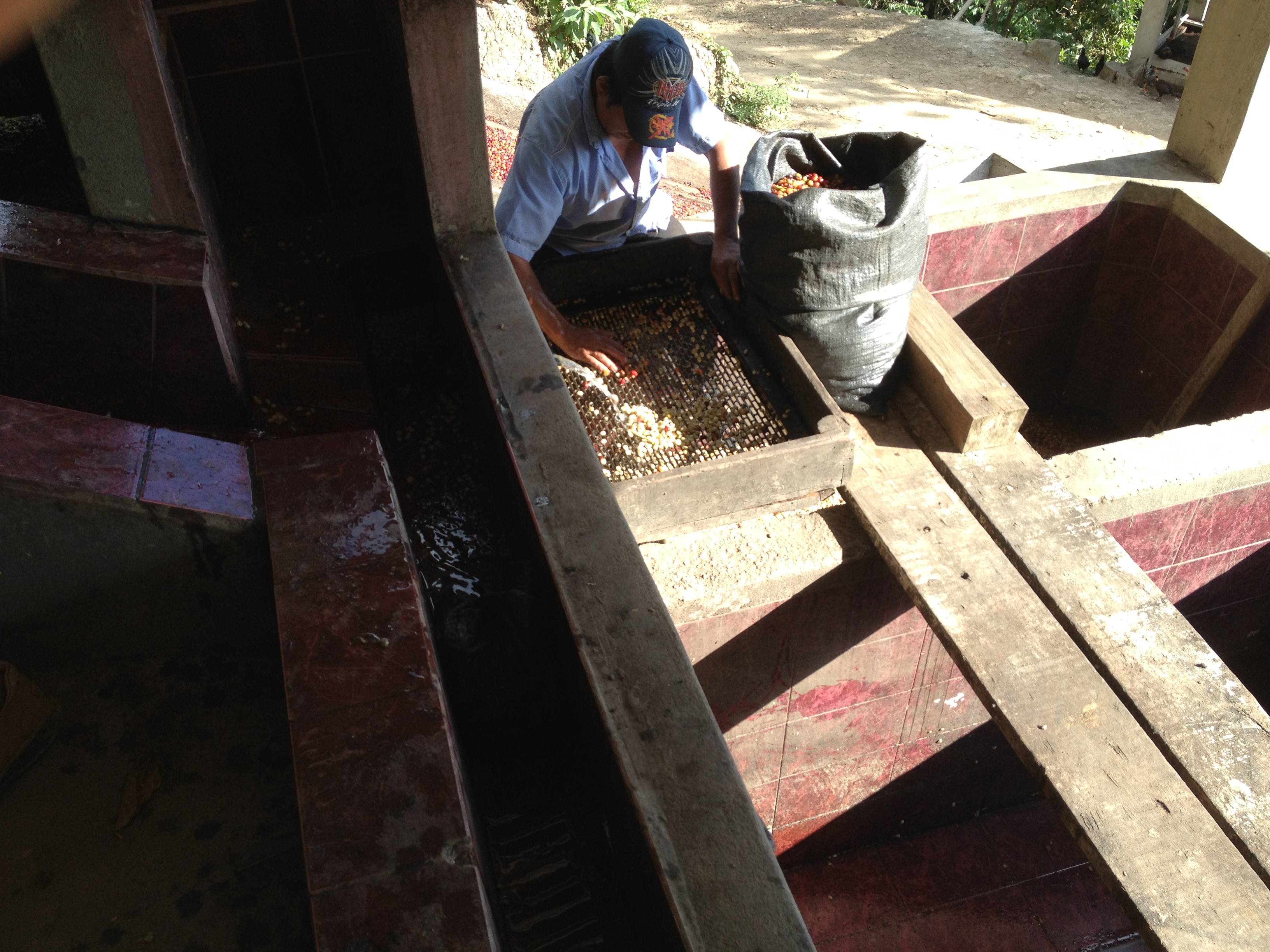
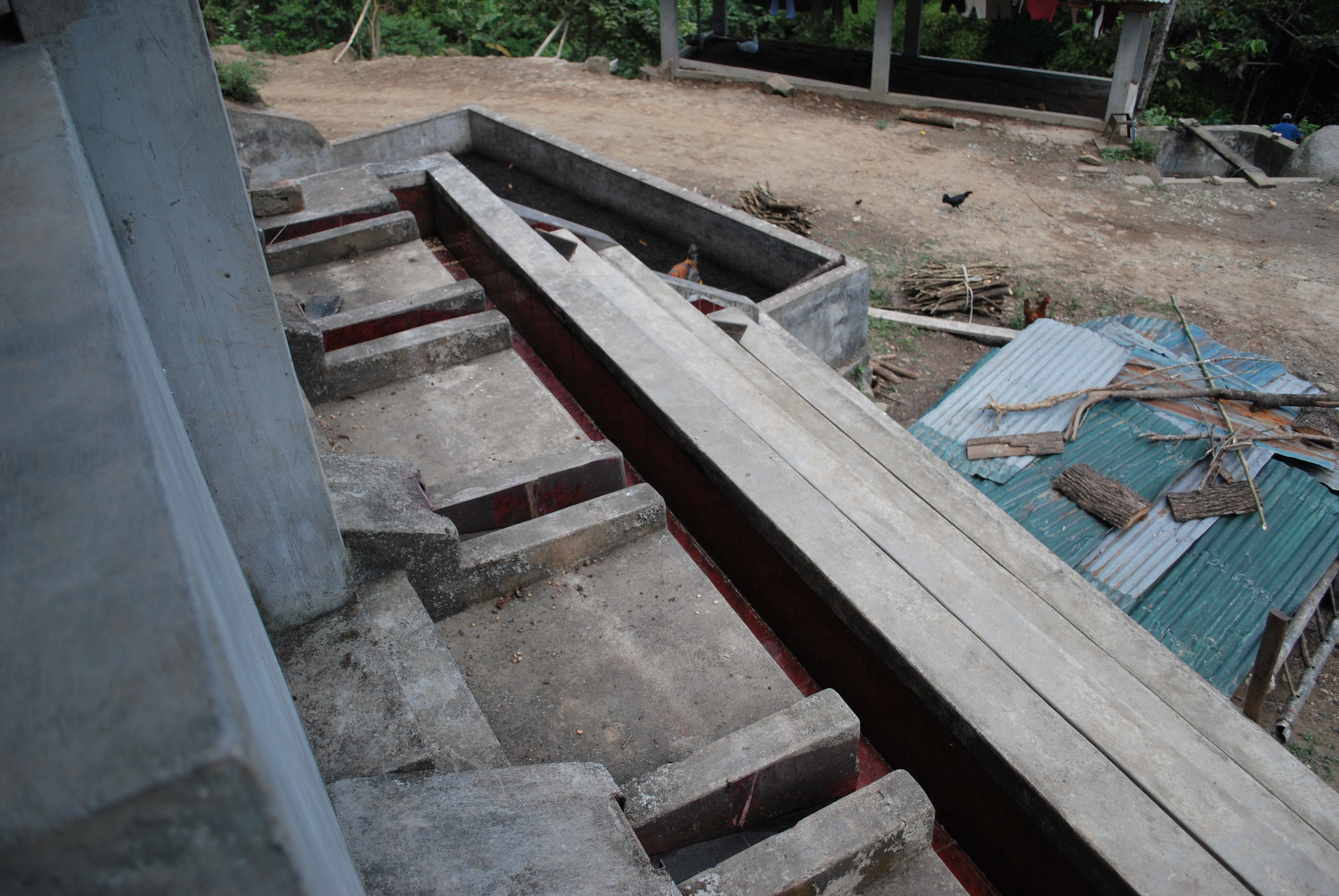
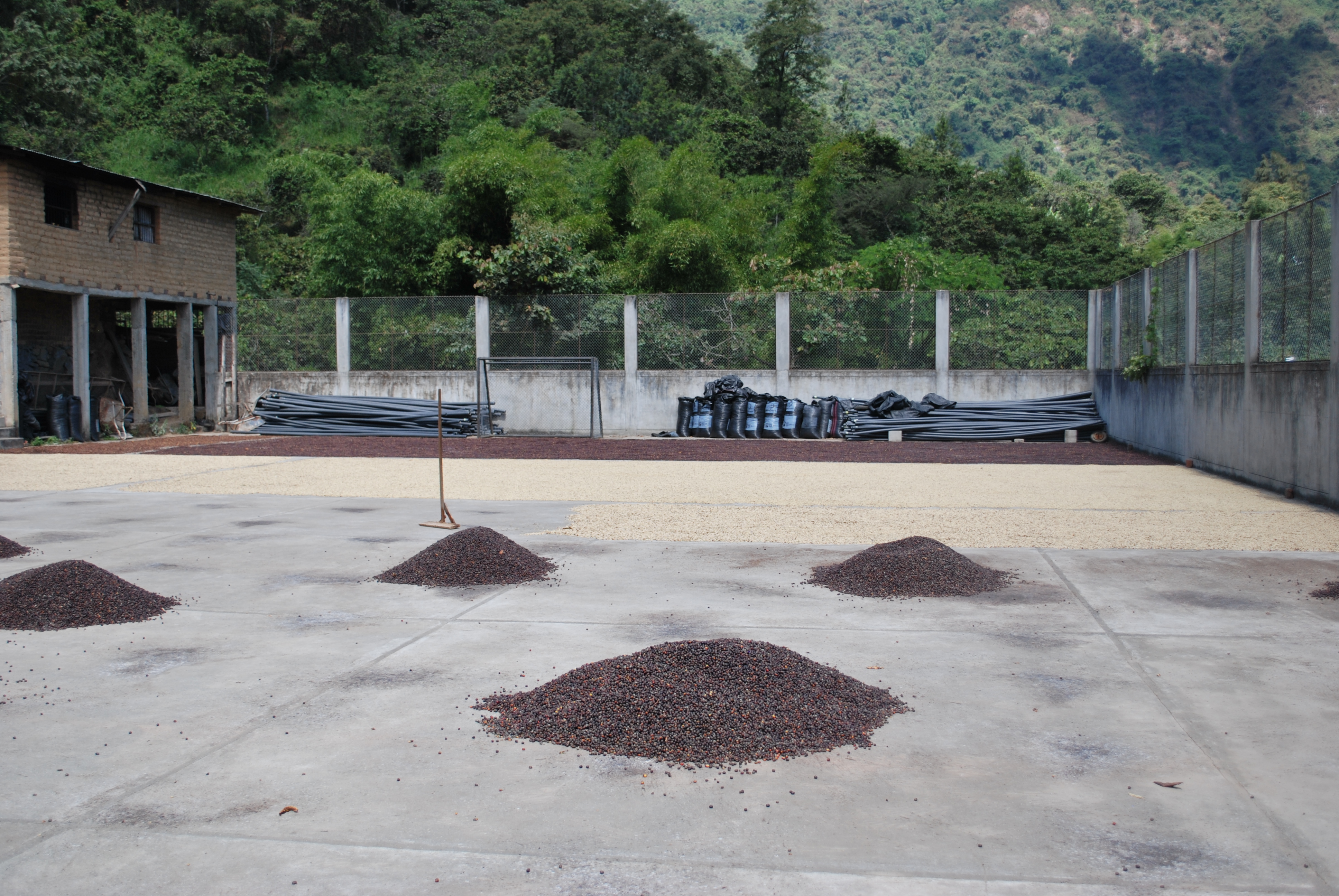
Coffee has been grown in Coyona for 70 years. They use a wet process on the cherries which yields a better quality end bean. Their processing facility is in the middle of the village and is impressive for it’s efficiency. You see, they built it right into the mountain so they could use gravity to their advantage. The entire co-op helped build it – they figured it would ‘cost’ one week of labor per co-op member so they all pitched in, most working more than their one week commitment. Those who were unable to work the week ‘paid’ in coffee to the co-op. Side bar – I particularly loved that the patio where they dried the beans featured soccer goals and seating for community games!

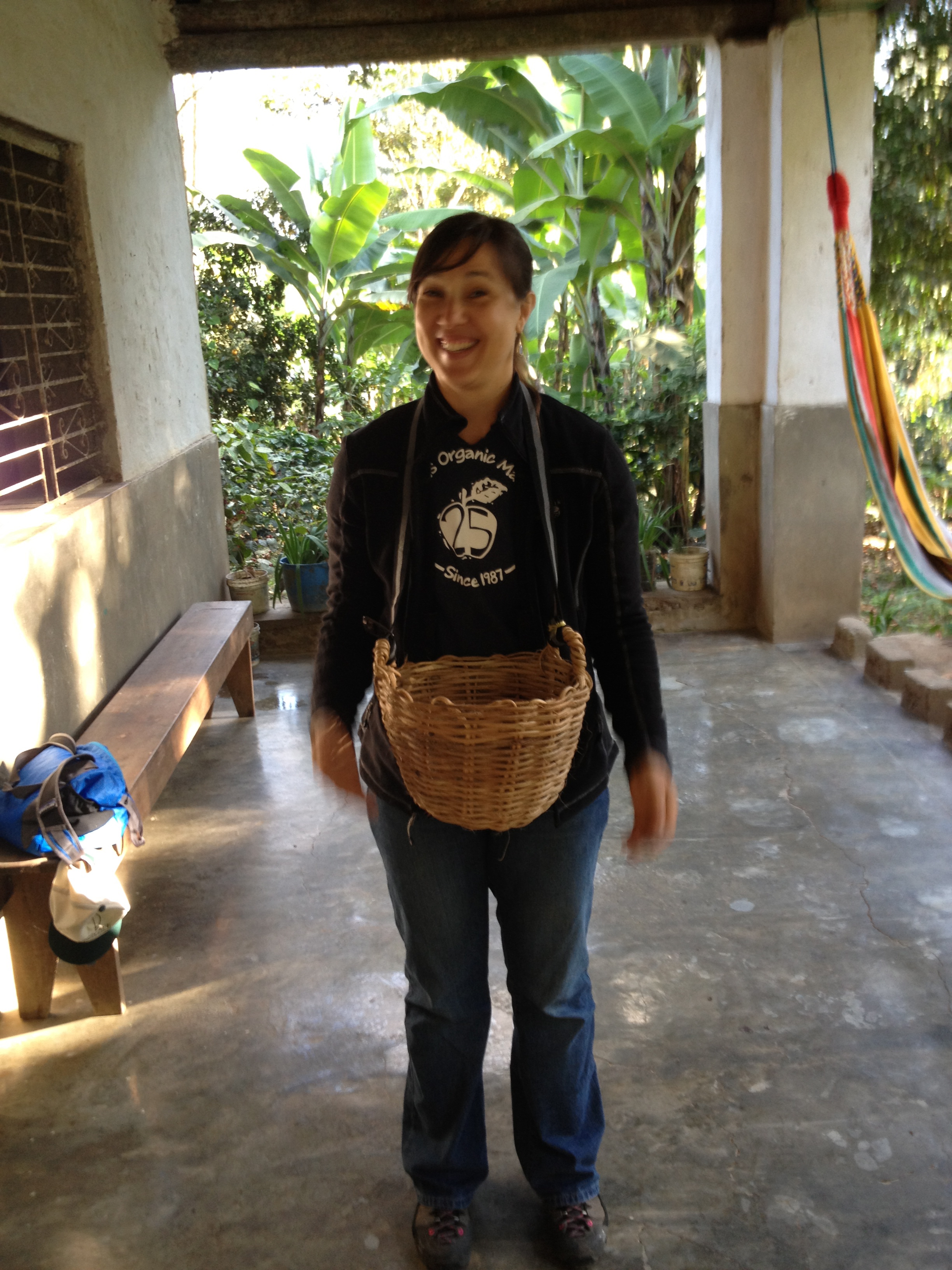
Our second day in the village we picked coffee cherries in the mountains alongside the socios, or co-op members.Image

The co-op has their own land and the individual farmers also have private land. The members get day wages to pick coffee on the co-op land thus supplementing their income. We picked on the co-op land which was steep to say the least! In the 4 hours or so we were picking I don’t think my feet were ever on level ground.

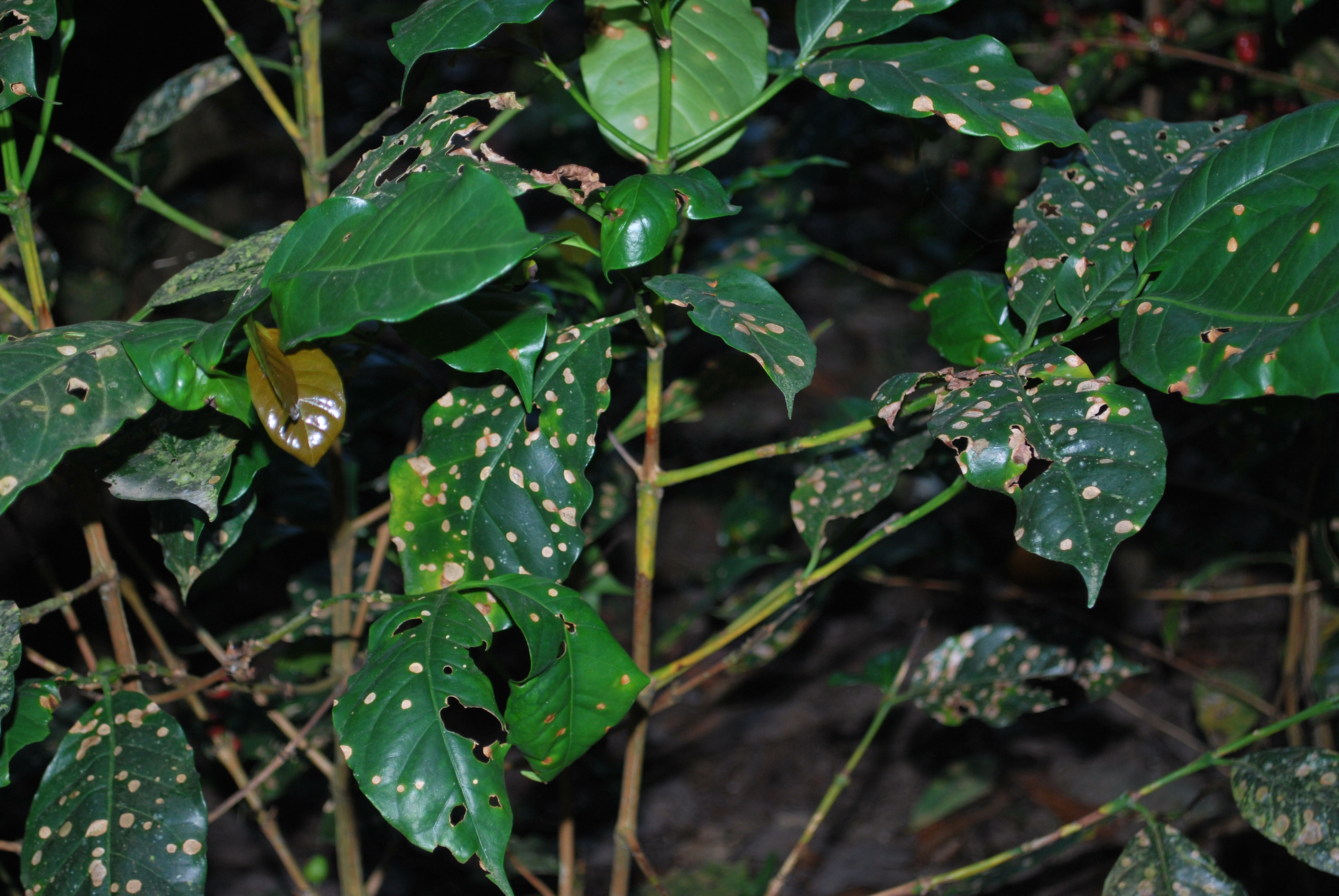
Picking the cherries was was simultaneously exciting and frustrating. Sergio, the GM of JGC, warned us of two diseases that are affecting the crop, Ojo de Gallina (rooster eye) and Roya Amarilla (yellow rust).ImageImage

It’s become so bad that 4 years ago they were producing 225,000-250, 000 lbs of export and this year they are hopeful to get 100,000 lbs. When we asked what was causing the disease the reply was climate change. The clouds which usually come in and go out allowing the coffee bushes to dry thoroughly have been literally hanging around too long. The excess moisture is what’s causing these diseases to occur. Even worse is that if you touch the yellow rust and then move on to another tree to pick you could pass the disease on to that tree. While it doesn’t affect cherry quality it significantly reduces the quantity of cherries that bush will yield.

The day we picked with the co-op we picked a total of 40 lbs of export. Not bad but I could definitely improve technique. The masters picked double what we could in the same time frame!

Once we picked the cherries they were moved, by burro, down to the processing facility. The first step was to dump them into the water and those that floated were skimmed off and the ones that sunk were good and moved on to depulping. First they are passed through a sieve to remove the outer layer by hand.Image

This doesn’t remove everything though so then it’s on to the electric depulper. This removes all of the outer fruit to reveal the ‘green bean’. From here they were put into the fermenting vat to sit for 24 hours. When they’re ready to go the beans are run through a switchback canal to wash them again and then they go underground across the road to the patio.

Image

Once they reach the patio they are ready to be spread out and dried, needing to be raked every 6 hours to make sure it’s done evenly. Once dried they are bagged and taken to Piura for hulling and roasting.

Image

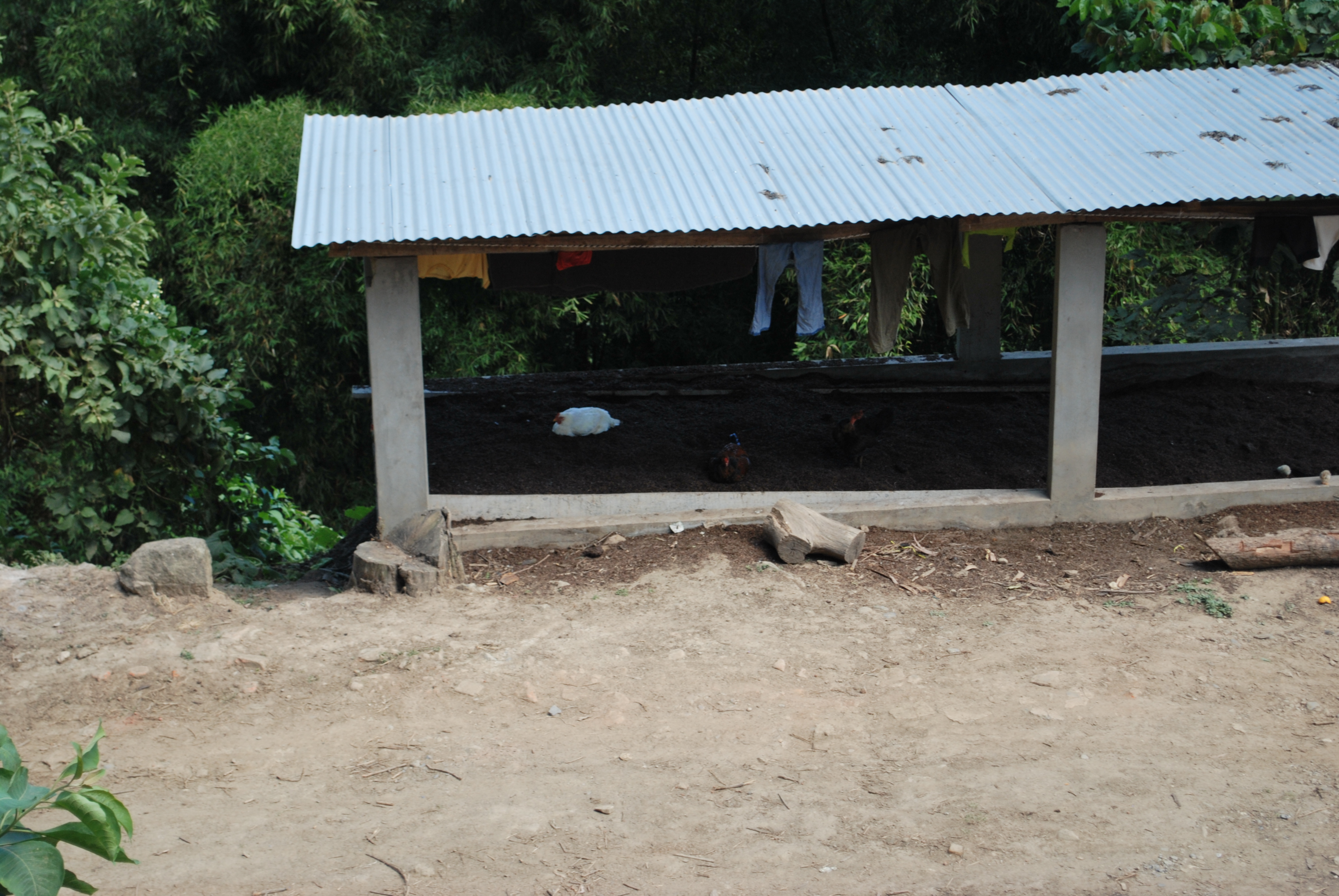
There is a tremendous amount of leftover cherry shells which they compost. By the following season those are ready to be spread on the co-op land as nutrient rich additive. There are a couple of agronomists who work with the co-op to promote sustainable agriculture and to help get the most they can out of the land.

Image

The people of Coyona were great hosts. We had a big community party with lots of dancing and an impromptu banjo session with Joe from Greenstar Co-op in NY state. We also got a special treat from the primary school. We were there right around their Independence Day (Fiesta de Patrias) and as a result got to participate in their celebration.

Image

It was an amazing experience I won’t soon forget. Stay tuned for more!

Image


Claudia works at MOMs Central.
Posted in Climate Change, Ecology | Tagged , , , , , , , , , , , , , , , , , | Leave a comment

What’s Cookin? Chunky Gazpacho Soup

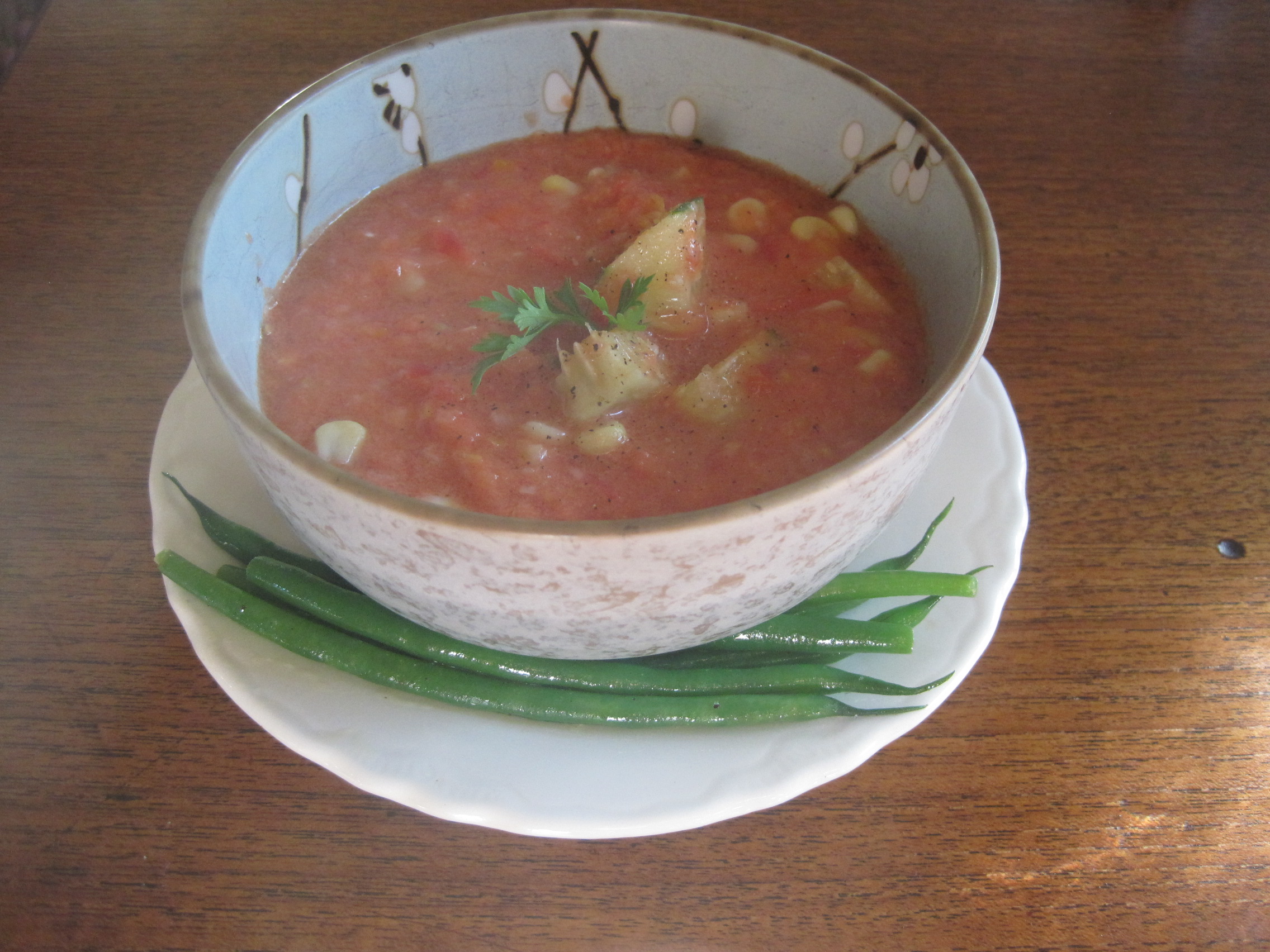
IMG_2409People love soup, but many of us don’t feel like a hot meal in the middle of summer!  Enter gazpacho.  Gazpacho is a cold, fresh soup, usually tomato-based, and originating in the southern region of Spain.  This gazpacho is partly blended and partly chunky to mimic the texture of the warm soups we’re used to.

This recipe is vegan and gluten-free.  Takes about 30 minutes to prepare and serves 6.

IMG_2404Gazpacho Soup

Ingredients:
3 vine or heirloom tomatoes, chopped
1 red bell pepper, chopped
1 yellow bell pepper, chopped
2 garlic cloves, peeled
1 small shallot or vidalia onion, chopped
(shallot for a stronger flavor)
IMG_2406IMG_24073 Tbs. water
1 Tbs. lime juice
1 Tbs. sherry vinegar
2 Tbs. olive oil
¾ cup sweet white corn (frozen, canned or fresh)
1 cucumber, chopped
salt & pepper to taste

Instructions:
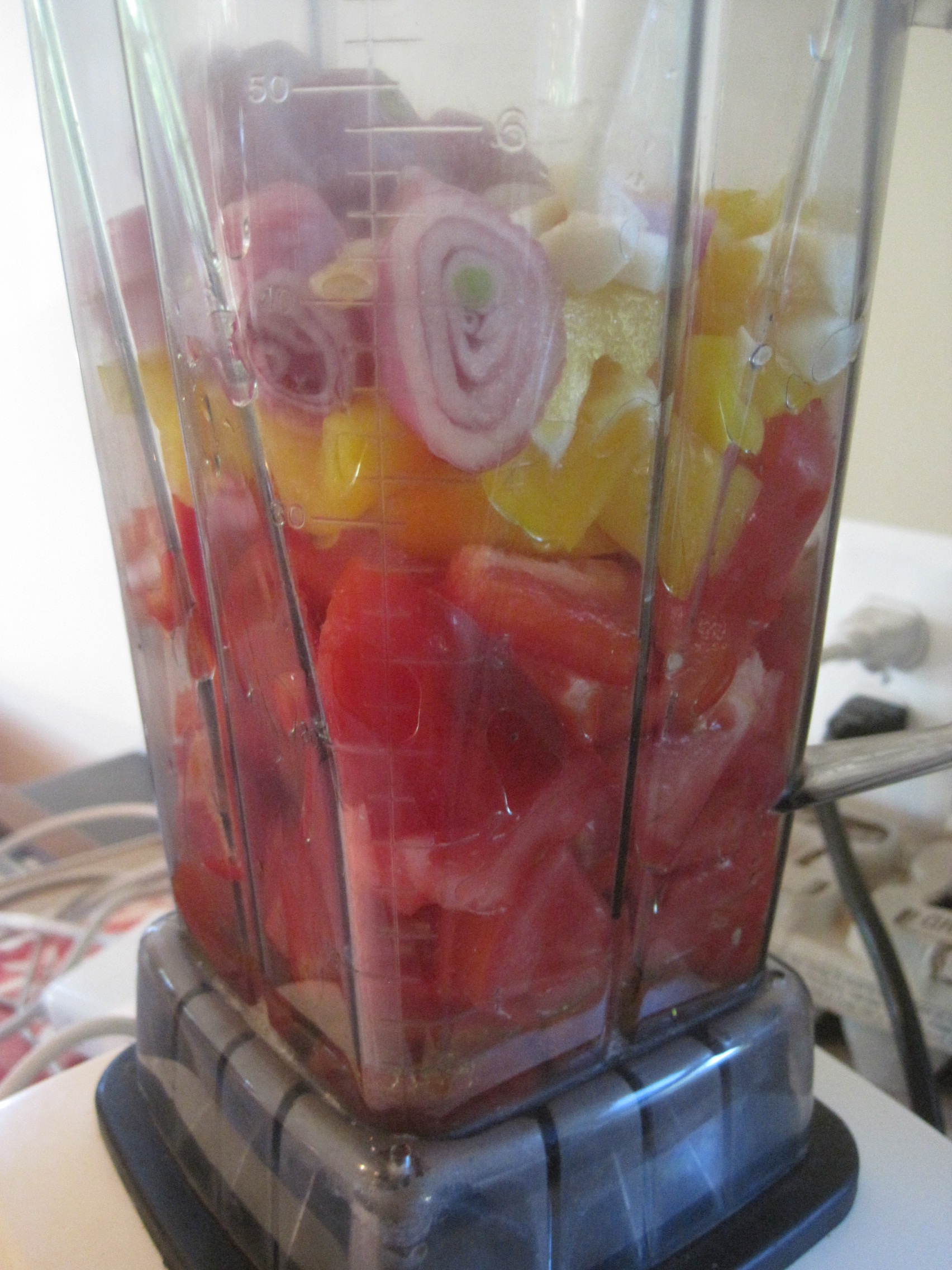
IMG_2408Place your chopped tomatoes, peppers, shallot or onion, garlic, lime juice, oil, and vinegar in the blender.  Process until it reaches your desired consistency.

Transfer the gazpacho to a bowl.  Add the chopped cucumbers and corn, and season to taste with salt and pepper.

Enjoy!

Eva works at MOM’s Central Office.

Posted in Recipes | Tagged , , , , , , , | Leave a comment

MOMs on the Bay

Employees from the Alexandria store had a great bay adventure recently with the Chesapeake Bay Foundation. Read on for Alex’s rundown on the awesome day.

“It was a balmy summer morning, with the promise of Washington’s finest heat and humidity just around the corner. Twenty or so of my esteemed MOM’s colleagues were starting to assemble near our bus; ready to board for the trip down to Washington Harbor in Southeast D.C. for a day on the water learning about the the Chesapeake Bay Watershed with some good folks from the Chesapeake Bay Foundation (CBF). That this bus was leaking oil – spewing, really – into our parking lot was not yet known, but was in fact a mishap that would lead us to quite a different mode of transit to our destination. Luckily, as this is MOM’s we are talking about, several folks were on point with kitty litter and corn meal to stop the oil from taking over the lot.

Perhaps an hour later, with some wheeling and dealing by both Katie and David, an average looking, though much larger, bus appears. Apparently, this one had just driven all night from either Vegas or South Beach, and was probably going to be disappointed to be filled with budding environmentalists on their way to study water quality and marine life rather than the party animals for which it was so clearly designed. I don’t know if it was the Miami Vice décor, the strobe lighting, or the other interior accents (the description of which would prevent this from being a family show), but the reaction from everyone as we filed on was truly classic. Finally, we were ready to roll, though heading to the SE Harbor Waterfront truly seemed like going down the bunny slope for this black diamond bus.

Despite the rough beginning and the hilarious mode of transit, we made it in record time to our meeting place and were cheerfully greeted by Clair, who was to be our guide and educator for the day. She and Eric, whom we would meet on board the Susquehanna, are Eastern Shore natives and CBF educators who regularly take 4th graders out on the water during the school year. We were all pretty slap-happy from the morning’s events as well as the thrill of being outside of work, but Clair took us all in stride, led us to the porta-potties and talked to us about our sunscreen and hydration needs. While I was never made to feel like a 4th-grader, I suspect she didn’t much alter her game with us!

CBF pic 1

Once on board, we were delighted by the scenery and the binoculars. Throughout the day, we would see osprey and their nests, and well as several bald eagles flying above. We learned from each other that not all of us had much first-hand experience with the Watershed, nor with being onboard a boat, and the day’s agenda was going to be perfect for us. Clair began by taking a sample of the water from where we started and grabbed another sample about mid-way through our journey to compare the two, although in this instance there wasn’t much of a noticeable difference. Then we moved on to the maps, which were fascinating! We divided up into 4 groups, with each of us looking at different maps of the watershed region. It was interesting, and sad, to learn of all the changes that have taken place that negatively affect the water. Also interesting was learning just how vast the watershed region really is. Who knew that it spanned six states and the District, with the majority of several of those states lacking much direct access?

SONY DSC

Perhaps the most fun was trawling for fish with a giant net. Within five minutes, we had caught various species of perch and catfish, as well as mud snails and some vegetation (a good sign because if it is growing underwater, the clarity must be at least somewhat healthy). We placed our catch amongst four receptacles and gave them some oxygen for the few minutes that we had them to help them survive in the small quarters before we released them back to their habitat. The catfish were pretty intense looking, and all but one of the fish we caught were healthy. Our guides agreed that catching that much in fairly shallow water was a good sign for the health of the river as well. I might add that shortly before the trawling, we passed a water treatment plant, said to be the largest in the world, of its kind, and also the largest single-point discharger into the Bay. According to our guides, there has also been raw sewage leaking into the Potomac after heavy rainfalls. And apparently, DC has a terrible sewer system, with wooden pipes that are archaic at best.

cbf pic 2

Our last endeavor was the water testing. This was really cool – not only to compile the results, but also just to see what tools are used. We checked for the salinity and turbidity of the water, as well as the amounts of phosphate and nitrate found in the water. Though both the salinity and turbidity of the water are a concern, the results we found for nitrates and phosphates were dismal. Our tests showed that the levels were well above what should ever be present in a healthy body of water. Our guides explained that with the overabundance of these nutrients in the water, there is a decrease in oxygen levels for all the beneficial living organisms, which turns bodies of water in to dead zones; bad for everybody. The general cause for these areas of concern is human-related and stems from storm water run-off and the increase of non-porous surfaces. Things such as pesticides and other elements – the byproducts from construction, mining and agriculture (and leaky buses) – make their way into the water and serve to deplete the oxygen levels thereby “starving” the plants that fish feed on as well as keeping oxygen from the fish themselves. All in all, a bad scene and the Chesapeake Bay is (in)famous for it.
Ironically, as we were having this discussion, we were passing by Mt. Vernon where, right on the waterfront, there is obvious construction. What would George say? Makes you want to raise oysters and plant trees, all the time.

cbf pic 4

So, after a morning and early afternoon of parading as cartographers, naturalists, boat drivers, and chemists, our day with the good folks from the CBF drew to a close. I left the docks of the SE harbor with a deeper appreciation for and understanding of the Chesapeake Bay Watershed and the threats to its health than when I had arrived, and was ever grateful to MOM’s for offering this opportunity to the staff. Back on board the party bus, we were all much more subdued, calls for naptime and showers replaced the earlier chants for happy hour, and the CSNY ballad was a perfect ending to a wonderful aquatic adventure.”

Alex works at MOMs Alexandria.

Posted in Ecology, Local, Water | Tagged , , , , , , , , , , , , , , , , , , , , , , , | Leave a comment

Ramadan for a non-Muslimah

RamadanEach year a dear friend invites me to observe Ramadan with her family.  What is Ramadan?  Ramadan is the 9th month of the Muslim lunar calendar.  Practicing Muslims fast during this month as a way to reflect on their spiritual lives and renew their devotion to God.  It is a time to change habits and improve yourself.  Feeling hunger throughout the day reminds you to stay spiritually present and aware.

Like Muslims around the world, this morning I arose at 3:50 AM to eat breakfast and drink water.  Fasting starts at dawn with Fajr, the first prayer.  Muslims pray five times a day, and fast during Ramadan between the dawn prayer and the sunset prayer, Maghrib.  Today, that means no food or water between 4:12 am and 8:27 pm.

But it’s more than a physical fast.  Muslims often abstain from smoking, sexual relations, bad-mouthing and swearing while they fast.  Observing Ramadan reminds me to be conscious of my thoughts and words and mindful of my mental and spiritual health.  As I pray five times I remember my friend’s sick mother, my family, and another friend’s financial challenges.

I’ve fasted for 1 day of Ramadan for 4 years now.  Every year I get nervous!  I think, how will I get through the day without water?  Will I get anything done at work?  Will I be shaky from low blood sugar? (And to think I only fast for 1 day, not a month!) 

Every year it’s easier than I anticipate.  I don’t mean it’s easy, but every year I’m surprised to realize that I don’t need to eat and drink to feel like myself.  However, it makes me realize that food is important to me.  Every other day of the year I structure my schedule around food – getting breakfast, taking a lunch break, and making dinner.  Food is social, too!  How often do you meet up with friends for a coffee, lunch, a picnic or dessert?

Produce

I love working for MOM’s.  Not only do I have access to loads of beautiful, fresh, organic food, but I have the chance to learn about and appreciate how food gets to MOM’s and to my table.  I’m so grateful that I have quality organic produce close by!  I’m grateful to the farmers and many people who make it easy for me to eat.  Every Ramadan, abstaining from food for a day reminds me that food is meaningful.  It also reminds me of other important things: being kind, speaking and thinking well of others, working hard, and spiritual wellness.  It reminds me of the bounty I have.
Have a blessed Ramadan!

Posted in Holidays | Tagged , , , , , , , , , | Leave a comment

A Visit to BioSphere: Montreal

My husband and I took a trip to Montreal this Spring and had a great time. There are many great things about the city, which is known among many other things, to be rather forward-thinking when it comes to environmental practices.

On our outings around town it was hard to miss the Biosphere on the city’s landscape, and photo-49we finally found our way to the island and through maze-like directions (that steer you towards a giant amusement park oddly enough) to the Biosphere, an environmental education museum.

Now, I’m a DC-area native, meaning it rubs me a bit when I have to pay to enter a museum. I know, I know, that’s a DC thing – the free museum, that is – but it just never seems right to me to have to pay for a museum and perhaps as a result, I’m usually disappointed by the experience. Pulling up to the building, the sphere is quite impressive and cool nonetheless.

So the parking was $16. And the admission for two adults was $24. That’s how my visit started. I was given a little clippy thing to put on my clothing as my ticket I guess. I was then directed to start in one room (Room 1) and to proceed into Room 2 when I was done, and so on.

The exhibits seemed to revolve around a central theme of fashion. While Montreal is photo-52photo-50known for being a city of fashion, I was immediately skeptical about whether they could maintain this theme and still be serious about environmental education. Fashion and environmental education seem, on a value level, to be miles apart in my mind.

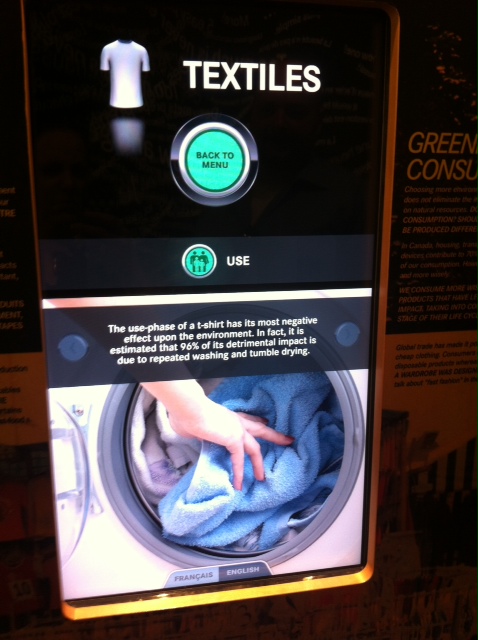
The first room contained a lot of information about fabrics, the pesticides and chemicals used to make them, and the energy used to care for them, and the waste they create when they are discarded. I briefly noticed a fact about Texas being the largest producer of cotton. Surely, I thought, China or India is a larger producer of cotton, but it must’ve said largest in the Americas or something like that. Tires, and other popular non-fashion items were discussed at length also.

The next room was a pretty cool interactive room for kids to learn about water’s properties, man-made effects on waterways, surface tension and buoyancy. We were slightly unprepared to get wet but there were several splashy surprises amongst the gears, suctions, wheels and toys. One portion, where we were playing with toy dams and widening channels, I noticed the explanation of why digging out harbors was bad for the environment was described as “it perturbs peoples’ lives” or something very similar. I chalked it up to poor translation and hoped most kids were learning a better French version. At least the families seemed to have great fun getting wet.

We moved on to another room; this one a lab-type room set up with an experiment board. Visitors were directed to research towards an answer to this question: “What is worse: Air pollution or water pollution?” What a question I thought!

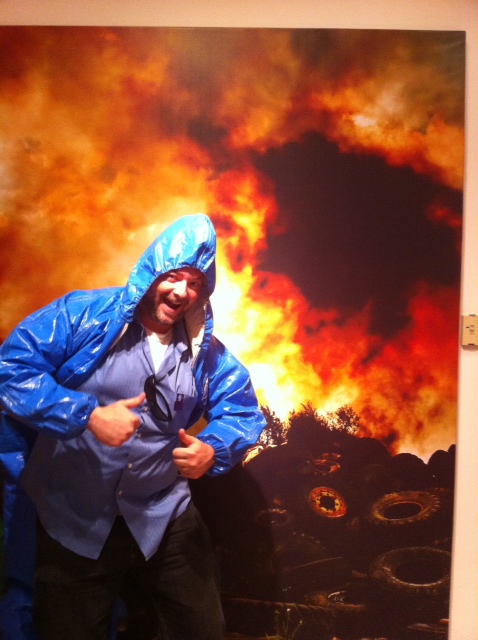
Well, part of the lab room was activity #4: “Smile! Put on a bio-hazard suit and take a photo in front of the environmental disaster.” Yep, that was an actual activity. Of course we complied. We’re still not sure if it was hilarious or horrifying (looking at the photo I think its probably hilarious).

hubby studying water parasites

hubby studying water parasites

Smile!

Smile!

The rest of the lab activities were fairly interesting and would certainly interest any science-minded child. The end result was that air pollution is worse for people and water pollution is worse for the earth. Ok, sure.

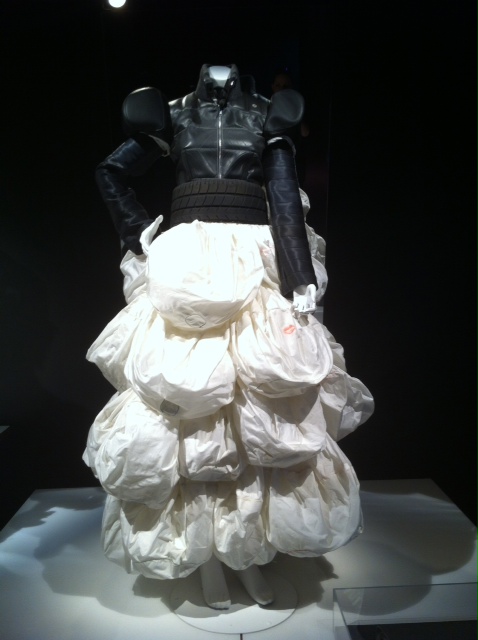
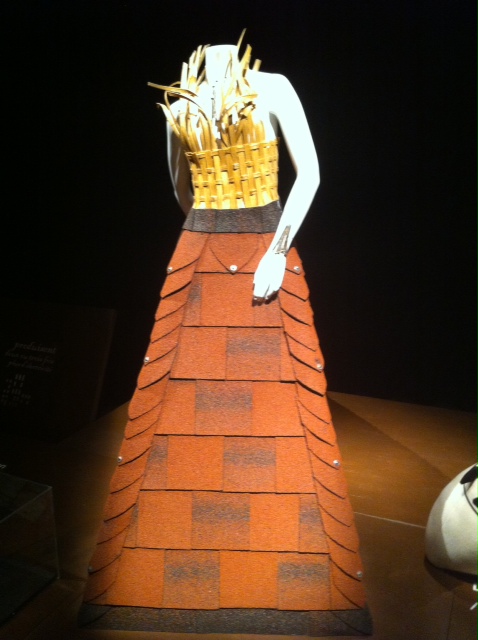
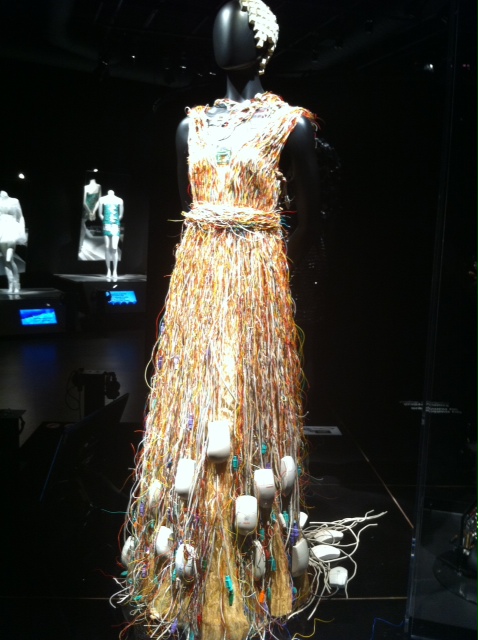
The ONE (Outfits for a New Era) exhibit is a black room with displays of dresses made from excess materials with a blurb, or a video about the material and its problems with environmental soundness. Batteries, roofing materials, styrofoam material, computer mice, dog waste bags, Arizona Tea cans, paper, hair, and about a dozen more. It was a bit overwhelming to try to look at all the dresses and their blurbs, but one stood out: it was a dress in a glass-door refrigerator like one you’d find in a gas station. The dress was made from salmon skin and mussel shells and the blurb was about sustainable seafood.

Air bags, hoses & tires

Air bags & tires

Arizona Tea

Arizona Tea

roofing materials

roofing materials

computer mice

computer mice

Ammo!

Ammo!

Hair

Hair

Salmon skin and mussel shells

Salmon skin and mussel shells

Batteries

Batteries, assorted varieties

There was a live environment room, glassed in from all sides, but the door was locked. Upstairs there was a lengthy exhibit of different energy production methods. Outside on the terrace was a shell of an electric car, and a cut away of an old 70s sedan with a look at the progression of cars over the decades, complete with a photo of a young woman with a voluptuous figure and a tiny top posing in front of a hot rod.

Looking over the balcony, one could see a bit of a green roof below. The view, from most sides, was beautiful. Overall, not a lot was learned, but there was a take-away brochure that gave a list of many good things to do at home for the environment (they should have included don’t pick up unnecessary brochures that you’ll just have to recycle later!).

photo-38

Inside the BioSphere looking out over the island

photo-40

Hubby in a energy producing wheel

car

Cutaway of a car and its parts

photo-37

French electric vehicle called an “Electrique” on display

♦♦♦ I went by the lady’s room on the way out and thought how nice it would be if they showed some examples of cleaning products that would be safer for the environment. When the toilet flushed, it seemed like 500 gallons of water was used for a basic flush – certainly a more powerful flush than I’ve ever witnessed before. Sigh, I thought.

The grounds were nice, and they apparently filter their water in the plantings in the garden.

If you find yourself in Montreal and have a day to kill driving around a little island looking for the Biosphere, check it out. But if you’ve only got one day and a twenty dollar bill in your pocket, spend it on a Cirque-style show at TOHU instead (the university for acrobats) – it was phenomenal and only cost $18! Plus they compost and recycle there.

[Montreal is a beautiful city – not to be missed!]

insideout

Alyssa works at multiple MOMs locations.

Posted in Climate Change, Ecology, Energy Resources, Family, Water | Tagged , , , , , , , , , , , , , , , , , , , | Leave a comment

What’s Cookin? Breakfast Pizza

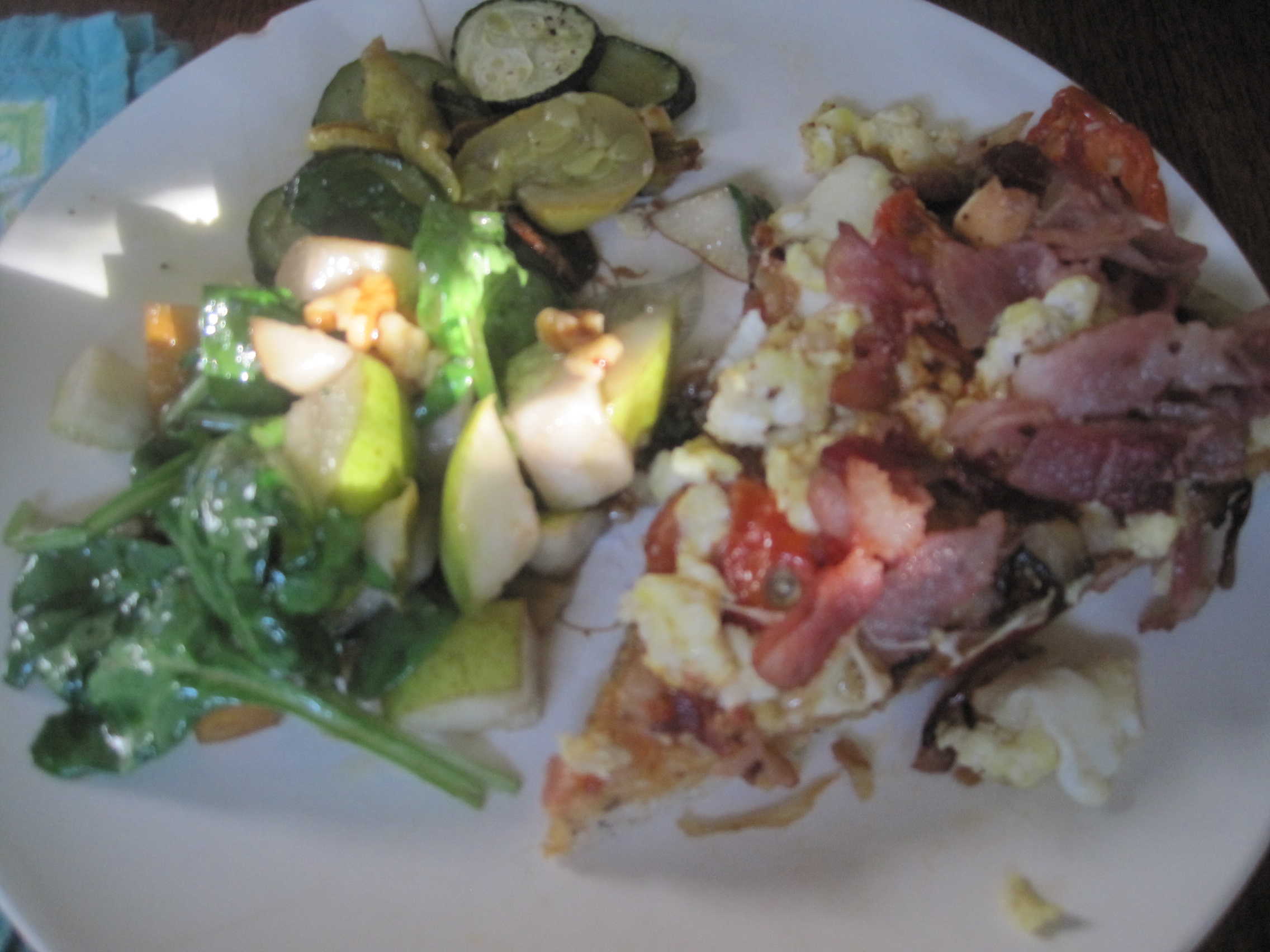
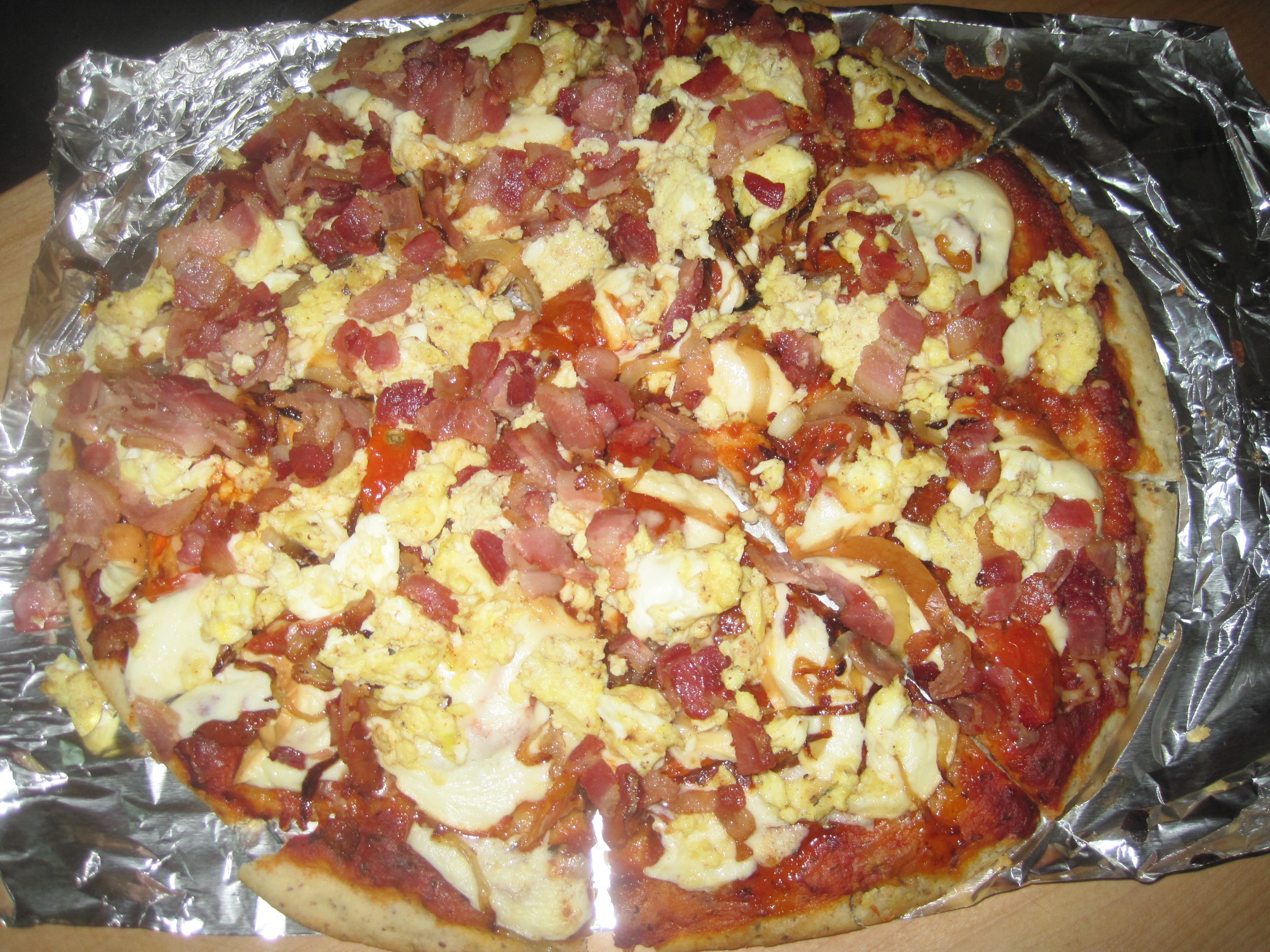
IMG_2342When I first saw this pizza sampled at MOM’s in Rockville, I was skeptical.  Turns out, it’s delicious!  This pizza makes a great dinner or brunch.  The roasted tomatoes and mozzarella add a delicious smoky flavor.

This is an omnivore’s pizza, but could easily be gluten-free with a gluten-free crust, and vegetarian by using vegetarian sausage.  Takes 1 hour to prepare.  Inspired by MOM’s employee Tammy Moore.  

Breakfast Pizza

Ingredients:
1 pre-made pizza crust
1 can organic pizza/pasta sauce
1 cup roasted tomatoes
1/2 lb. smoked mozzarella cheese, sliced
IMG_2334Shredded mozzarella (optional)
1/2 onion, chopped
Olive oil (for sauteing the onion)
3 eggs, scrambled
1 pack uncooked bacon, chopped

Instructions:
IMG_2336Preheat the oven to 400˚.  Start by cooking the onion and bacon.  You could cook them together in the same pan or cook separately, as I did.  These can cook 20+ minutes, depending how well-done you like your onion and bacon.  Once they are cooked, set aside.

In a separate pan, scramble the eggs until done.  Set aside on IMG_2337a plate.

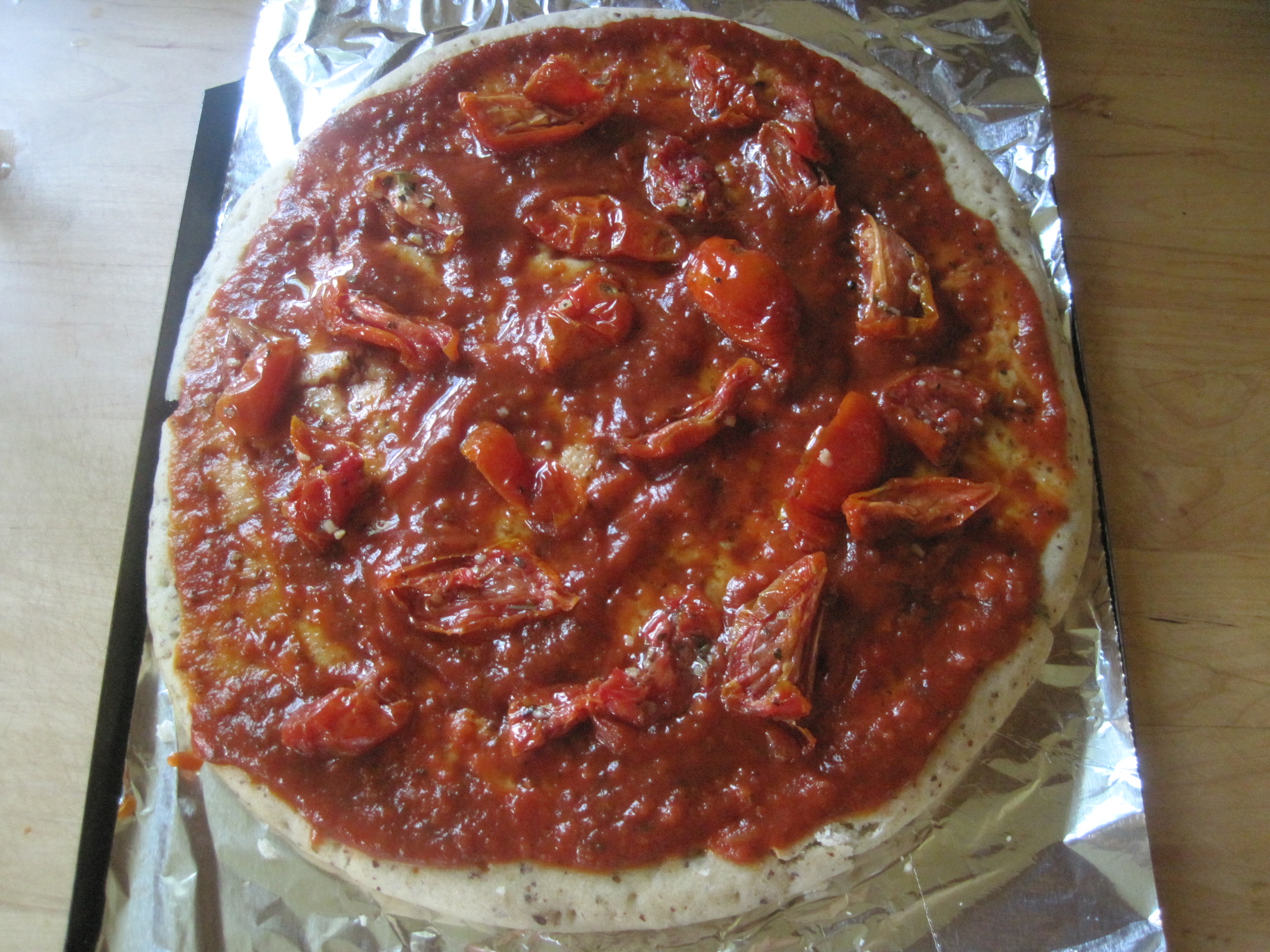
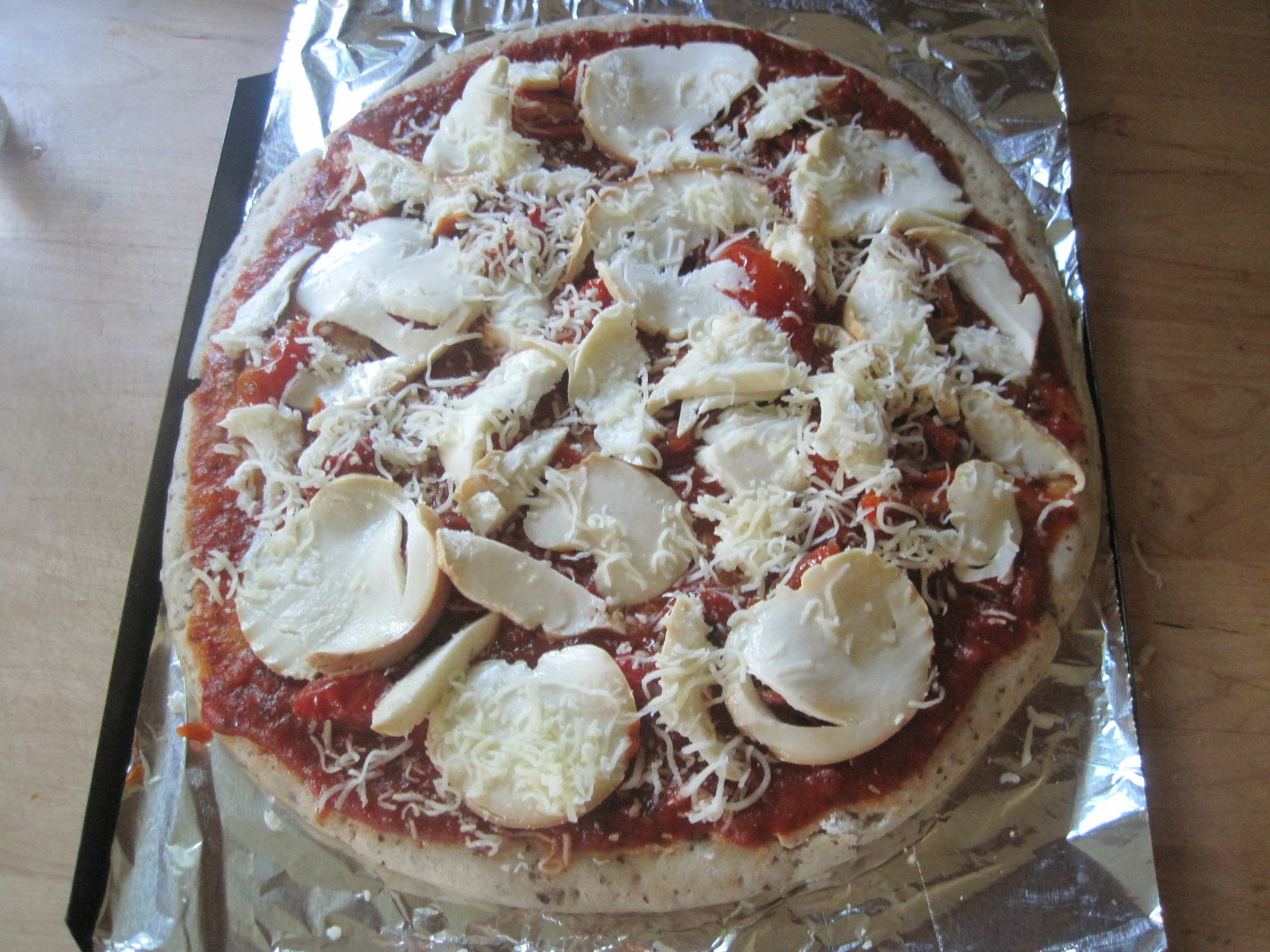
Meanwhile, place the pizza crust on aluminum foil over a baking sheet cover the pizza crust with sauce and roasted tomatoes.  Then, cover with the slice smoked mozzarella.  Some of the sauce will still be visible.  Feel free to sprinkle with extra grated mozzarella if you like.
IMG_2341
Next, cover the pizza with roasted onions, scrambled eggs, bacon bits and salt and pepper (optional).  Slide the pizza into the oven and bake for 10 minutes, or longer if you like very crisp crust!  Take the pizza out and serve hot.

Enjoy!

Eva works at MOM’s Central Office. 

Posted in Recipes | Tagged , , , , , | 1 Comment